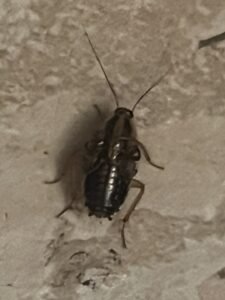
A baby German cockroach is the single most useful thing you can find during an inspection, and most people walk right past it. It’s smaller than a grain of rice, it’s not the right shape, and nobody told you what to look for. So it gets ignored, or worse, misidentified as a bed bug or a beetle while the actual breeding site sits one cabinet over, untouched.
Here’s the system: what a German cockroach nymph looks like at each stage of growth, how to rule out the insects it gets confused with, and what the find is actually telling you about the infestation.
Why a Nymph Matters More Than an Adult
An adult German cockroach can walk in from almost anywhere, a bag, a delivery box, a shared wall. A nymph can’t. It hatched close to where you found it and hasn’t traveled far since, because at this size and this fragile, distance is a death sentence. Low humidity and a long walk across open floor will kill a young nymph before it ever reaches shelter.
That means a nymph isn’t just evidence of cockroaches. It’s evidence of a breeding site within a few feet of where you’re standing, active and producing offspring right now. One adult is a maybe. One nymph is a confirmed local colony.
The Six Molts: What Changes and When
A German cockroach nymph doesn’t grow smoothly. It grows in jumps, shedding its entire exoskeleton at each molt (instar) and emerging slightly larger and slightly more adult-looking every time. Researchers have documented anywhere from five to seven molts depending on temperature and food availability, but six is the typical count, spread across roughly 50 to 90 days depending on conditions.
Instar 1 (newly hatched): About the size of a pinhead, roughly 3 millimeters, or an eighth of an inch. It emerges from the egg case pale, almost white, and darkens to black or near-black within hours of hatching. One pale stripe runs down the center of the back. No wing buds of any kind. This is the stage people most often mistake for something other than a roach, simply because it looks nothing like the adult.
Instars 2 through 3: Slightly larger each time, still dark with that single center stripe, still wingless. Around the third molt, the pattern starts to shift, the single pale center stripe begins to split and reorganize into the two separate dark stripes that run down the pronotum in adults. This is the clearest mid-stage tell: a tiny dark roach whose stripe pattern is “in transition” is almost always a third-instar German cockroach nymph.
Instars 4 through 5: Now carrying the recognizable twin-stripe pronotum pattern, closer in proportion to an adult but still noticeably smaller and still fully wingless. Small wing pads may become visible on the back as flat, non-functional nubs, present but useless, since true flight wings only finish developing at the final molt to adulthood.
Instar 6 (final nymphal stage): Close to adult size, roughly three-eighths to half an inch, with the full twin-stripe pattern clearly set. Still wingless or carrying only undeveloped wing pads. One more molt turns this stage into a reproductively mature adult with full, functional wings, though German cockroaches rarely use them to fly.
What a Baby German Cockroach Is Not
Three other small pests get mistaken for roach nymphs constantly, and the mix-up sends people looking in the wrong place entirely.
- Bed bug nymphs. A bed bug nymph is broader, flatter, and distinctly oval, closer to the shape of a tiny apple seed than an elongated insect. It has short antennae and moves in a slow, deliberate crawl. A German cockroach nymph has an elongated oval body, antennae as long as or longer than itself, and bolts the instant it’s exposed to light. Speed is the fastest tell: if it sprints for cover, it’s a roach.
- Carpet beetle larvae. These are fuzzy or bristled, often with visible hairs along the body, and they move slowly, if at all. Cockroach nymphs are smooth-bodied and fast. No roach nymph looks fuzzy under normal lighting.
- Small ants. Ants have a distinctly segmented, pinched waist and six legs arranged for a different gait entirely. A roach nymph’s body is one continuous flattened oval with no narrow waist. If you can see a “pinch” between body segments, it’s not a roach.
Why Nymphs Are the Most Vulnerable Stage
Every molt is a brief window of danger. Right after shedding its exoskeleton, a nymph is pale, soft-bodied, and defenseless until the new cuticle hardens, usually within a few hours. During that window it can’t run effectively and has no protective shell. This is also why nymphs stay deep in harborage far more consistently than adults: a newly molted nymph caught out in the open is an easy target for dehydration or predation, so the colony’s youngest members are almost always the ones hiding deepest in the wall void or cabinet seam, not the ones you see crossing the kitchen floor at night.
Reading What You Found
Use what you’ve seen to calibrate how serious the situation is:
- No nymphs, only adults. Possible hitchhikers or a very new, not-yet-reproducing introduction. Worth monitoring closely before assuming an established colony.
- A few small nymphs in one spot. An active, localized breeding site nearby. Treat that specific harborage directly.
- Nymphs at multiple visible stages in the same area. Overlapping generations, meaning the colony has been established and reproducing continuously for a while. This calls for the full elimination system, not a spot treatment.
The Bottom Line
A baby German cockroach isn’t a smaller, less important version of the problem. It’s the clearest evidence you can get that a colony is breeding within a few feet of where you’re standing. Learn the six-stage progression, rule out the bed bugs, beetles, and ants it gets confused with, and read the find correctly: nymphs don’t wander in from outside. They’re born exactly where you found them.
Once you’ve confirmed what you’re looking at, the next step is putting that evidence to work. The full identification and elimination system, from reading the colony’s signs to shutting it down, is laid out in the German Cockroach Field Manual.
Sources
- Koehler, P.G., Oi, F.M. German Cockroach, Blattella germanica (EENY-002). University of Florida IFAS. View publication
- German Cockroach (FS1322). Rutgers New Jersey Agricultural Experiment Station. View publication
- Differential development and survival of Blattella asahinai and Blattella germanica at six constant temperatures. Journal of Economic Entomology. View study