You did everything right. You baited, you sealed, you cleaned out the cabinets, and for two weeks your kitchen was clean. Then they came back. Not because your work failed. Because your apartment was never a sealed system to begin with. Somewhere on the other side of a wall, a neighbor’s untreated kitchen has been re-seeding yours the entire time.
That’s the piece almost nobody tells apartment residents: in multi-unit housing, the German cockroach’s real territory isn’t a kitchen. It’s the building.
THE SHORT VERSION
- Your apartment shares plumbing, wall voids, and utility runs with every unit around it — and German cockroaches use them as highways, not barriers.
- Treating your own kitchen doesn’t stop reinfestation from an untreated neighbor’s wall. The population there keeps breeding and walks straight back in.
- Only coordinated, building-wide treatment breaks the loop. Individual effort matters, but it isn’t sufficient on its own.
Your Unit Is Not a Sealed Box
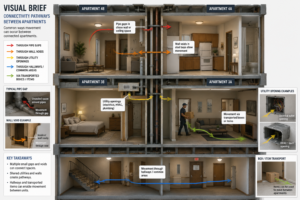
Every apartment shares infrastructure with the units around it, and every shared connection is a route a roach can travel without ever crossing open air. Plumbing chases run vertically through multiple floors. Electrical conduits and cable runs pass through wall studs from unit to unit. Shared wall voids sit behind drywall that’s common to two apartments at once. Drop ceilings and utility corridors connect entire wings of a building.
Researchers tracking German cockroaches inside apartment buildings found interapartment movement as high as 30 percent of the population per week where the building’s construction allowed it, with the heaviest traffic between adjoining kitchens. In a 188-unit high-rise studied for building-wide pest control, infestation wasn’t random: if one unit had roaches, the units next to it, across the hall from it, and directly above or below it were far more likely to have them too.
What this means for you: the roach on your counter may not be a resident of your apartment at all. It may be commuting.
Why Treating Your Unit Alone Fails
Picture it from the colony’s side. You spray, bait, and seal your kitchen. Inside your walls, that pressure works, and the population there collapses. But the wall itself doesn’t end at your drywall. It continues into your neighbor’s unit, where nothing changed. Survivors on that side keep breeding, and their offspring don’t recognize a property line. They walk back through the same plumbing penetration that let their parents leave.
You didn’t lose. You won a battle in a war being fought on a map you can’t see. Every apartment you can’t treat is a source of reinfestation for every apartment you can.
This is exactly why building-wide IPM studies show something individual treatment can’t: when every unit in a building is treated together, the correlation between neighboring infestations disappears. Roaches stop reappearing next door because there’s no next door left breeding them.
What You Can Control vs. What You Can’t
Draw this line honestly before you plan anything, because it decides where your effort should go.
You control:
- Everything inside your own unit: sanitation, sealing, bait placement, monitoring
- What you report, and how clearly you report it
- Whether you push for a building-wide response or quietly treat your unit alone and hope
You don’t control:
- Whether your neighbors treat their units
- Whether the building schedules coordinated pest control
- What’s happening inside the walls you share
The mistake most residents make is spending 100 percent of their energy on the first list and 0 percent on the second: fighting the visible symptom while ignoring the structural cause.
The Resident’s Playbook: What You Can Do From Your Side
You’re not powerless while you wait on the building. Do this regardless of what happens next door:
- Seal every penetration you can reach. Pipe entries under sinks, gaps around the water heater, holes behind the stove and refrigerator: pack them with copper mesh, then seal over it with caulk or expanding foam. This won’t stop movement through voids you can’t access, but it closes the exits and entries in your own unit.
- Bait, don’t spray. A gel bait in cracks and corners lets roaches carry the kill back to a harborage you’ll never find, including ones that may extend into a shared wall. A contact spray only kills what it touches and pushes survivors deeper into the structure, often toward your neighbor.
- Add an insect growth regulator. Because reinfestation from a shared wall is constant, killing today’s adults isn’t enough. You need something suppressing the next generation while the building-wide problem gets addressed. An IGR does that work in the background.
- Monitor and document. Sticky traps near suspected entry points (behind the fridge, under the sink, along baseboards shared with a neighboring unit) turn a vague complaint into a data-backed case. Record dates, counts, and locations.
- Watch which wall. If activity concentrates against one specific wall, floor, or ceiling, that’s a strong clue about where the source is. That detail is exactly what a building manager or pest control company needs to act on.
Getting the Building on Board
A single resident rarely gets a whole building treated by asking nicely once. Make the case with evidence and know what you’re entitled to.
- Report it in writing, not just verbally to a super or maintenance worker. A written complaint creates a paper trail and, in most jurisdictions, starts a legal clock on the landlord’s obligation to respond.
- Cite the pattern, not just your unit. “I have roaches” is easy to dismiss. “I have roaches concentrated against the shared wall with unit 4B, worsening over three weeks, documented on sticky traps” is much harder to ignore.
- Ask directly for a building-wide inspection, not just service to your apartment. Pest control companies default to treating only the unit that complained unless the property manager specifically authorizes a wider scope. You may need to request it by name.
- Know that habitability law is usually on your side. In most U.S. states, an ongoing pest infestation that a landlord fails to address after written notice can be treated as a habitability violation, with remedies ranging from repair-and-deduct to formal complaints with local housing authorities. Read your lease and local tenant law before you need it, not after.
Coordinated Treatment: What Actually Works
When a building does respond, the difference between a real fix and a temporary lull comes down to whether the response is coordinated or unit-by-unit.
Effective building-wide programs move on several units at once, not sequentially. Treating one apartment, then waiting weeks before the next, gives survivors time to re-seed the units already finished. The research is consistent on this: programs that combine sanitation education for residents, gel bait in every treated unit, and IGRs to suppress reproduction, applied building-wide rather than apartment-by-apartment, are what actually break the interapartment movement pattern. No single treatment does it alone.
If you’re a resident pushing for this, that’s the phrase to use with your property manager: coordinated, building-wide IPM, not spot treatment. Spot treatment protects nobody, including the unit that gets it.
The Bottom Line
In an apartment building, a German cockroach infestation is never really about one kitchen. It’s about a structure that connects every unit through pipes, conduits, and shared walls the colony reads as open highways. You can win everything inside your own four walls and still lose, because the war isn’t contained to them.
Control what’s yours to control: seal it, bait it, monitor it, document it. And push hard for what isn’t: a coordinated response across the building, backed by the pattern you’ve tracked. That combination is the only thing that has ever actually ended an apartment infestation for good.
The full elimination system, the bait rotation, the IGR pairing, and the sealing protocol that gives you the strongest possible position in a shared building, is laid out in the German Cockroach Field Manual.
Sources
- Wang, C., et al. Spatial Distribution of German Cockroaches in a High-Rise Apartment Building During Building-Wide Integrated Pest Management. Journal of Economic Entomology — the study behind the infestation-clustering and building-wide IPM findings. View study
- Distribution and Movement Patterns of German Cockroaches Within Apartment Buildings. Journal of Medical Entomology — the interapartment movement-rate and kitchen-adjacency research. View study
- Wang, C., Bennett, G.W. Cost and Effectiveness of Community-Wide Integrated Pest Management for German Cockroach. Rutgers University. View study