How P450 Enzymes Drive Chemical Resistance
German cockroach resistance isn’t luck. It’s biochemistry. Inside the P450 enzyme system that lets roaches survive your spray, and how to beat it. If you have ever sprayed a German cockroach (Blattella germanica) harboring a deep-seated infestation, only to watch the insect walk away completely unfazed, you didn’t just witness a failure of product chemistry. You witnessed a masterclass in evolutionary molecular defense.
The primary driver behind modern insecticide failures isn’t that pests are physically dodging the spray. It’s that their internal organs have evolved into high-speed chemical processing plants. At the heart of this biological shield is a superfamily of proteins known as Cytochrome P450 monooxygenases (P450s).
Understanding how these enzymes function is the key to dismantling the defenses of the modern “super-roach.”
THE SHORT VERSION
- P450 enzymes are the roach’s internal detox system. They bolt oxygen onto an insecticide and flush it out before it can kill.
- Under repeated chemical pressure, roaches overproduce these enzymes (gene amplification), reading a whole chemical class as harmless within a few generations.
- You don’t beat this with more spray. You beat it with biochemistry: synergists that clog the enzymes, pro-insecticides the enzymes activate by mistake, and strict Mode-of-Action rotation.
What Are Cytochrome P450 Monooxygenases?
Cytochrome P450 monooxygenases are a massive superfamily of enzymes found in virtually all living organisms. In humans, they reside primarily in the liver and are responsible for metabolizing medications and clearing daily toxins from the bloodstream.
Structurally, their primary chemical trick is simple yet devastating to synthetic chemistry: they insert a single atom of oxygen into a target molecule (hence the name monooxygenase).
In insects, this oxygenation alters the geometric and chemical structure of a compound. This usually renders it non-toxic and significantly more water-soluble, allowing the cockroach to flush the chemical out of its system safely and rapidly as waste.
The Ultimate Weapon of Metabolic Resistance
Pest management professionals deal with several types of insect resistance, such as target-site resistance (where the pest’s nervous system mutates so a chemical can no longer latch onto it) and the behavioral aversion that makes averse roaches taste sweet bait as bitter. However, P450s are the absolute rulers of metabolic resistance: the mechanism at the center of the super-roach’s biochemical armor. Instead of changing the lock so the key won’t fit, P450 enzymes intercept and destroy the key before it ever reaches the door.
Because German cockroaches live exclusively indoors in high-density environments and reproduce at an astonishing rate (a single egg capsule holds up to 40 nymphs), they face constant, repetitive exposure to the same handful of chemical classes. This creates an intense evolutionary crucible:
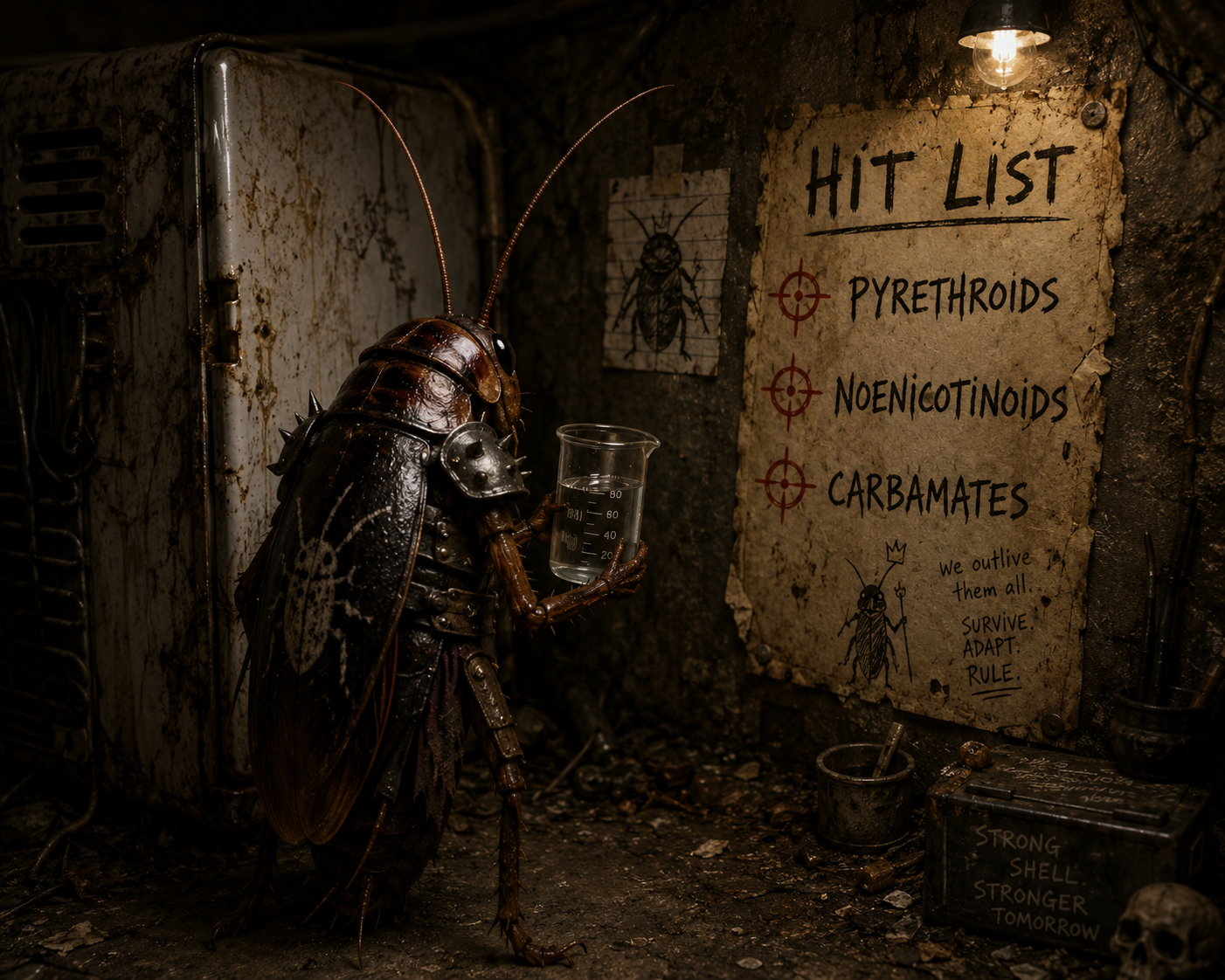
- The Chemical Pressure: An environment is repeatedly treated with traditional synthetic pyrethroids or neonicotinoids.
- Gene Amplification: Cockroaches possessing a genetic blueprint for elevated enzyme production manage to survive the treatment. Through a process called gene amplification, their DNA instructs their bodies to go into overdrive, flooding their systems with far more detoxifying P450 proteins than a normal, baseline cockroach would ever carry.
- The Resulting Super-Population: Within just a few generations, the local colony reads an entire chemical family as practically harmless. The moment a molecule of insecticide absorbs through their waxy outer cuticle, a wave of overproduced P450 enzymes binds to it, bolts oxygen onto it, and neutralizes it before it can reach its central nervous system.
How to Strip the Biochemical Armor
You cannot out-muscle metabolic resistance simply by spraying a higher volume of the same active ingredient. Doing so only accelerates gene amplification and hardens the population’s defenses. Instead, eradication requires using biochemistry against biochemistry.
1. Deploy Metabolic Synergists
The most direct countermeasure to P450-driven resistance is the use of a synergist, such as piperonyl butoxide (PBO). PBO has virtually no insecticidal knockdown power on its own; instead, it acts as a chemical decoy. PBO binds directly to the cockroach’s Cytochrome P450 enzymes, effectively “clogging” and paralyzing its internal defense system. With the P450s temporarily occupied, the primary insecticide can slip through undetected to deliver the lethal blow.
2. Turn Their Enzymes Into Executioners
Smart chemistry can turn a pest’s defense mechanism into its own executioner. Pro-insecticides, such as indoxacarb, are designed to be essentially non-toxic when the cockroach first makes contact or ingests them. However, when the cockroach’s internal enzymes attempt to break the chemical down, the metabolic process accidentally activates the molecule, converting it into a highly toxic metabolite. In short: the harder the cockroach’s metabolic defenses work, the faster it eliminates itself.
3. Implement Strict Mode-of-Action Rotation
The enzymes a German cockroach population builds to dismantle a pyrethroid spray are molecularly useless against an entirely different class of chemistry. Blindside the colony by switching to completely different modes of action, such as shifting from a pyrethroid residual spray to a localized avermectin or insect growth regulator (IGR) bait.
None of these levers is a silver bullet on its own. They’re a system. The Roach Doctrine lays out the complete bait-rotation matrix, the exact synergist-and-active pairings by phase, and the placement protocol that makes every treatment hit harder, executed in the right order. Enter the Doctrine, or start with the free field intel.
The Verdict
The prevalence of Cytochrome P450 monooxygenases proves that modern pest control is a dynamic biological arms race. Relying on a single chemical tool trains the colony’s internal chemistry to defeat you. By integrating synergists, deploying pro-insecticides, and rigorously rotating modes of action, you stop guessing why a treatment failed and start dismantling the cockroach’s evolutionary armor from the inside out.
Sources
- Scott, J.G. (1999). Cytochrome P450 monooxygenases and insecticide resistance in insects. Insect Biochemistry and Molecular Biology. View study
- National Pesticide Information Center (NPIC). Piperonyl Butoxide (PBO) General Fact Sheet. View fact sheet
- National Pesticide Information Center (NPIC). Indoxacarb information. View resource
- Review of insecticide resistance mechanisms and mode-of-action rotation. Toxics (MDPI, 2025). View review
Related Intel
- The Science of the Spray: Defeating the Super-Cockroach
- Understanding Metabolic Resistance: The Biochemical Armor of the Super-Roach
- The Biological Armor: How Roaches Amplify Their Genes to Survive Your Spray
Frequently Asked Questions
Why does my spray fail even when I hit them directly?
Often it’s not a dodge. It’s detox. Roaches overproduce Cytochrome P450 enzymes that bolt oxygen onto the insecticide and flush it out as harmless waste before it reaches the nervous system. The spray lands; their chemistry dismantles it.
What are Cytochrome P450 enzymes?
A superfamily of detox proteins found in most living things. In humans they clear drugs in the liver. In roaches they insert oxygen into an insecticide, making it non-toxic and water-soluble to excrete. Under repeated spraying they overproduce them until a whole chemical class reads as harmless.
How do you beat P450 (metabolic) resistance?
Not with more spray, with biochemistry. Synergists that clog the enzymes (PBO), pro-insecticides the enzymes activate into a toxin by mistake (indoxacarb), and strict Mode-of-Action rotation so the enzymes they built are useless against the next chemical.
What is a synergist and how does it help?
A synergist like piperonyl butoxide (PBO) temporarily disables the P450 detox enzymes. Paired with your insecticide it strips the biochemical armor so the primary chemical can reach its target. It doesn’t kill alone. It removes the defense.
What’s a pro-insecticide?
A chemical that’s harmless until the roach’s own enzymes activate it. Products like indoxacarb are switched on by the very detox systems the roach uses for defense. Turning its own machinery into the trigger that poisons it.