Understanding German cockroach behavior and biology is the difference between guessing and winning because you cannot out-clean, out-spray, or out-wait an insect you don’t understand. The roach on the counter is a symptom. The problem is a biological system built over millions of years to reproduce faster than you can kill, hide where you will not look, and survive on what you leave behind. Learn how that system works and every control decision that follows stops being a guess.
This guide breaks down the behavior and biology of the German cockroach, Blattella germanica (how it develops, feeds, moves, and survives), and translates each trait into what it means for the person trying to get rid of them. For the wider identification-and-control picture, this article expands on the German Cockroach Field Manual.
German Cockroach Behavior and Biology: The Six Advantages It Runs On
Kill an individual roach and you have performed a mechanical action. Eliminate an infestation and you have managed a population. The gap between those two things is where nearly every failed treatment lives, and it exists because the German cockroach stacks six biological advantages on top of each other:
- Rapid, overlapping reproduction
- Protected egg development
- A small, flattened body built for hiding
- Nocturnal, cover-seeking behavior
- Broad, opportunistic feeding
- Physiological and behavioral resistance to control
No single advantage makes them unbeatable. Working together, they explain why sprays fail, why the population is always bigger than it looks, and why the answer is never a bigger can of poison. Take them one at a time.
Advantage One: They Reproduce Faster Than You Can Kill
A single mated female German cockroach can produce several egg cases over her life, and each egg case holds dozens of developing offspring. Because generations overlap: adults, mid-stage nymphs, and freshly hatched young are all present and breeding at the same time. The population does not grow in steps. It compounds.
What this means for you: a treatment that kills 80 percent of what you can see has not won. The survivors and the eggs already in the system rebuild the population within weeks. This is why one-time efforts and single applications fail, and why real control is a campaign that keeps pressure on the population through several reproductive cycles, not a single strike. The full timeline lives in the German cockroach life-cycle guide.
Advantage Two: The Eggs Are Carried, Not Left Behind
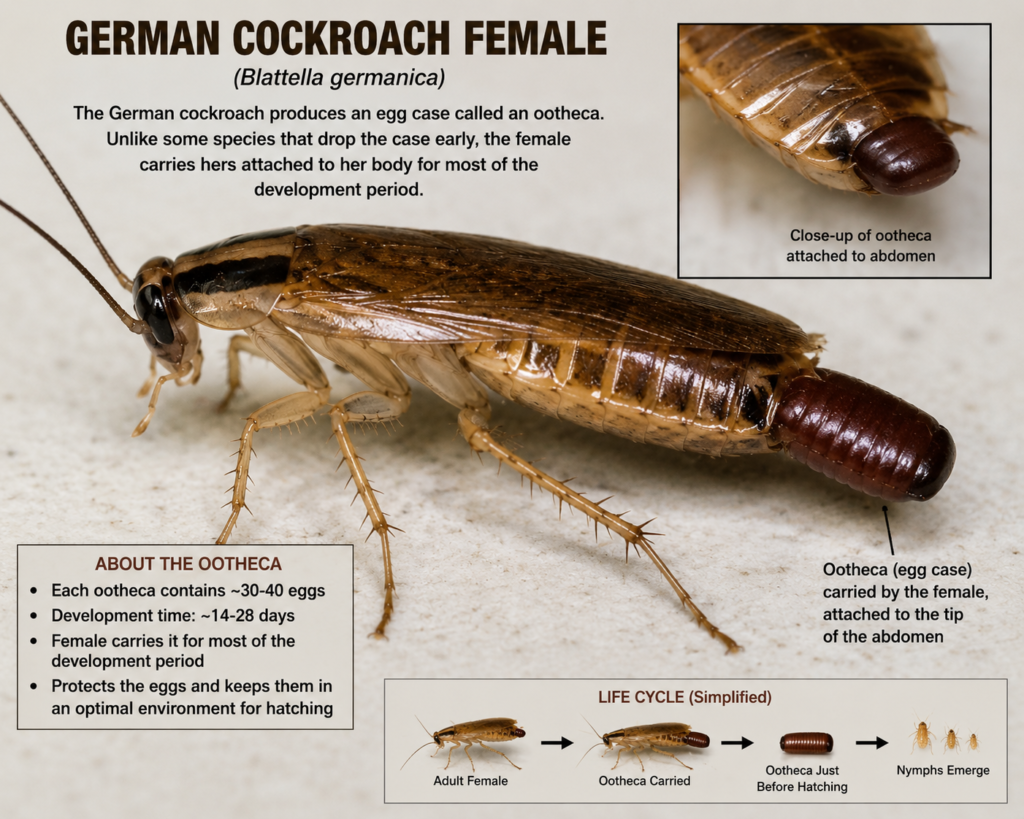
The German cockroach produces an egg case called an ootheca. Unlike some species that drop the case early, the female carries hers attached to her body for most of the development period, depositing it only shortly before the young hatch. That behavior shields the next generation from predators, disturbance, and, critically, from most contact insecticides.
What this means for you: spraying surfaces does little to the offspring, because they are riding on the mother or sealed in a case tucked deep in a harborage. A control program has to keep working long enough to catch those protected eggs as they hatch into vulnerable nymphs. Insect growth regulators earn their place here specifically because they attack the reproductive cycle instead of the individual insect.
Advantage Three: Their Body Is Built to Disappear
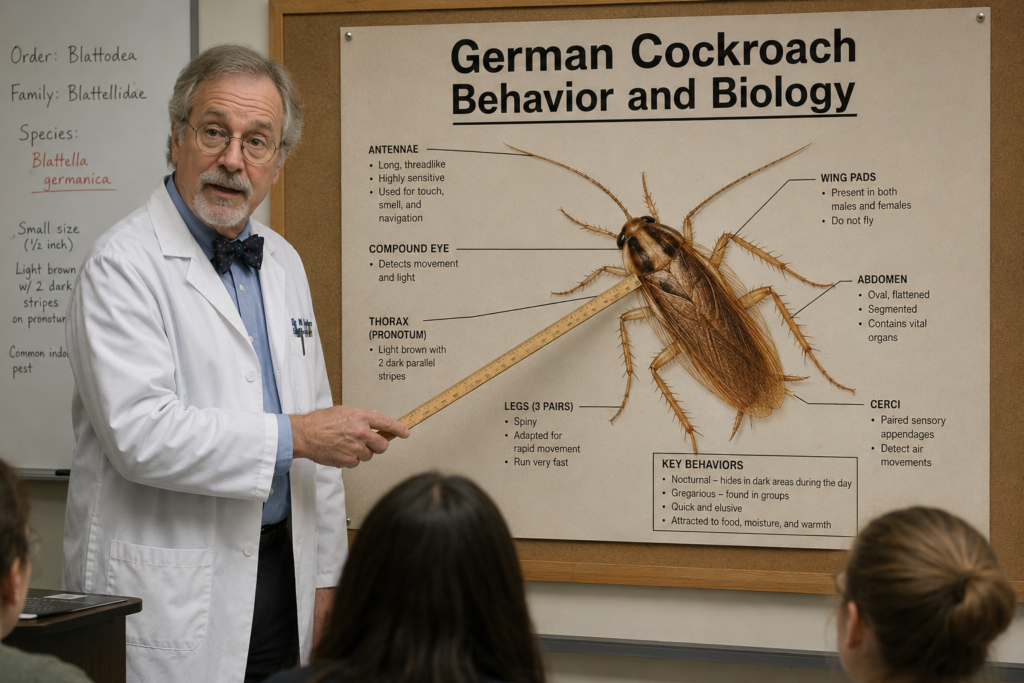
Adults are small, roughly half an inch, with flat, flexible bodies that slide into cracks no wider than a coin’s edge. Nymphs are smaller still, and the youngest can fit into spaces you would never think to inspect. German cockroaches have wings but rarely fly; they rely on speed and cover instead, darting for the nearest gap the moment light or movement reaches them.
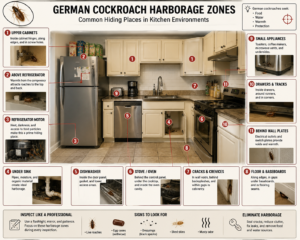
They seek out tight spaces where their bodies touch surfaces on multiple sides. These protected pockets are called harborages, and roaches gather in them in large numbers. This is the single most important fact about German cockroach behavior: the insects on the floor are only the fraction of the population that left cover. The real colony is behind the refrigerator, inside cabinet joints, in the motor housing of appliances, and inside wall voids.
What this means for you: you are never treating what you see. You are trying to reach what you cannot. Locating harborages beats chasing visible roaches every time. A deeper breakdown of their hiding logic is in the guide on where German cockroaches hide.
Advantage Four: They Own the Dark
German cockroaches are primarily nocturnal. They forage for food and water when the building is dark and human activity has stopped, then retreat to harborage before dawn. This is why an infestation can be well established before a resident sees more than the occasional roach. Most of the population is active during the hours no one is watching.
What this means for you: daytime sightings are a warning, not a baseline. When roaches are out in the open during daylight, it often signals crowding. The harborages are full and the population is being pushed into the light. Read that as evidence of scale, not a minor nuisance. The behavior behind night activity and daytime appearances is covered in the guide on why German cockroaches come out at night.
Advantage Five: They Eat Almost Anything
The German cockroach is an omnivorous scavenger. Crumbs, grease films, food residue, garbage, pet food, and spilled liquids all sustain it. So do things most people never think of as food: cardboard, paper, glue, soap residue, and organic debris in drains. It also needs water, which is why moisture (leaks, condensation, damp cabinets under a sink) is as much a driver of infestation as any crumb.
What this means for you: sanitation is not cosmetic, it is a control lever. Every competing food source you remove makes bait more attractive, because a hungry roach that cannot find grease under the stove is far more likely to eat the bait you placed. Cutting off water does the same work from the other side. This is the biological reason “clean up and fix the leaks” is not filler advice. It directly changes how well your treatment performs. The link between diet and bait performance is detailed in the guide on what German cockroaches eat.
Advantage Six: They Adapt to the Poison
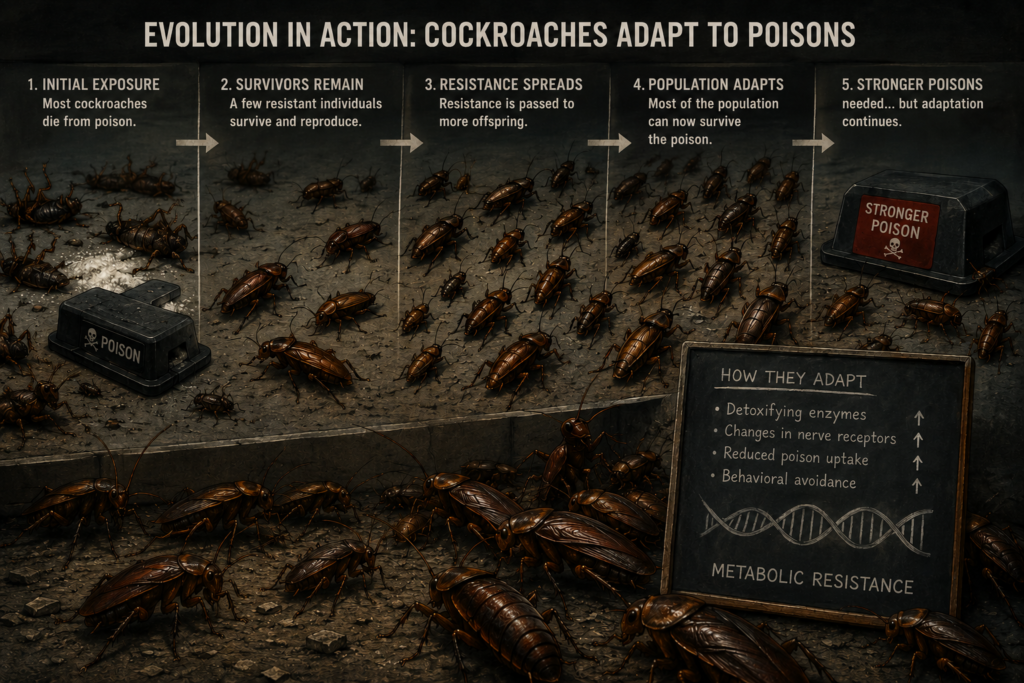
German cockroach populations have repeatedly evolved resistance to insecticides. Physiological resistance: the metabolic resistance built from enzymes that break the insecticide down before it can kill. Means the chemistry that killed the previous generation may no longer kill this one, because repeated exposure to the same active ingredient selects for the survivors that can tolerate it. There is also behavioral resistance: some populations have evolved to avoid the sugars used in certain baits, refusing to eat the very product meant to poison them.
What this means for you: leaning on one product, especially a store-bought spray hitting the same population week after week, actively breeds a tougher colony. Rotating modes of action, relying on baits and growth regulators rather than repellent sprays, and removing the conditions that support the population all matter more than the strength of any single chemical.
They Aggregate, but There Is No Queen to Kill
German cockroaches are often called colony insects because they gather in groups, but they are not organized like ants, bees, or termites. There is no queen giving orders and no worker caste. What draws them together is aggregation: chemical signals in their droppings and on their bodies mark good harborage, and roaches cluster wherever warmth, moisture, food, and other roaches meet.
What this means for you: there is no single target that collapses the population when destroyed. You cannot remove one insect and end the infestation. Control has to reach the whole aggregation. The upside is that their own biology can be turned against them. The same droppings that recruit roaches to a harborage also concentrate them where well-placed bait can reach many individuals at once.
Why This Biology Makes Them Hard to Eliminate
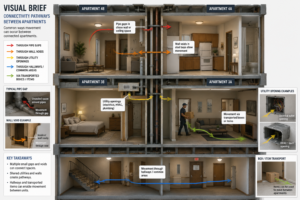
Stack the six advantages and the difficulty explains itself. A population reproducing on overlapping cycles, protecting its eggs, hiding in dozens of harborages, feeding at night on almost anything, and adapting to your chemicals is not going to fall to a single spray on a Saturday afternoon. In apartments and other shared buildings the challenge compounds, because roaches move between units through wall voids, plumbing penetrations, and shared utility lines. A neighbor’s untreated kitchen keeps re-seeding yours.
This is exactly why the Doctrine refuses to frame control as killing. Killing is what you do to the visible few. Elimination is what you do to the system: reduce the food, correct the water, locate the harborages, monitor to find where activity concentrates, deliver bait and growth regulators the hidden population will actually consume, and keep the pressure on across enough reproductive cycles that the colony cannot rebuild. Understand the insect and that sequence stops being a checklist and becomes obvious.
The Bottom Line
The German cockroach is not hard to kill. It is hard to eliminate, and the difference is biology. Rapid reproduction, protected eggs, a body built to hide, night activity, a scavenger’s diet, and the capacity to adapt to poison combine into an insect that thrives on everything an ordinary home offers and shrugs off everything an ordinary treatment throws at it.
You do not beat that with force. You beat it by removing the conditions it depends on and reaching the population it hides. The next move is learning to identify German cockroaches precisely, separating them from the species that call for a different approach, before you commit to a plan. Start with the German Cockroach Field Manual and work outward from there.
Frequently Asked Questions
How fast do German cockroaches reproduce?
One female produces several egg cases, each holding dozens of young, and generations overlap. Adults, nymphs, and hatchlings all breed at once. The population doesn’t grow in steps, it compounds. That’s why killing 80% of what you see doesn’t win: the survivors and eggs rebuild it within weeks.
Do German cockroaches have a queen you can kill?
No. Unlike ants or termites, there’s no queen and no central nest to destroy. They aggregate together but every female breeds independently, so control has to pressure the whole population, not hunt one target.
Will keeping a clean house get rid of them?
Cleaning helps but isn’t enough alone. German roaches eat almost anything (grease film, crumbs, glue, cardboard), and live where you can’t reach. Sanitation is one leg; without sealing harborages and breaking the breeding cycle, a spotless kitchen can still hold an infestation.
Why do I only see roaches at night?
They’re nocturnal and cover-seeking; flat bodies let them wedge into dark voids by day and emerge to feed after dark. Seeing them in daylight usually signals a heavy infestation forcing them into the open.
Sources
- NC State Extension. Biology and Behavior of the German Cockroach. Reproduction rate, ootheca-carrying behavior, and nocturnal activity. View publication
- Wada-Katsumata, A., Silverman, J., Schal, C. (2013). Changes in taste neurons support the emergence of an adaptive behavior in cockroaches. Science, 340(6135), 972-975. The glucose-aversion behavioral resistance study. View study
- Wada-Katsumata, A., et al. Gut bacteria mediate aggregation in the German cockroach. PNAS: the fecal-pheromone aggregation and harborage research. View study
- The impact of thigmotaxis deprivation on the development of the German cockroach (Blattella germanica). iScience: confirms the tight-space-seeking behavior behind harborage-hiding. View study
- Scott, J.G. (1999). Cytochrome P450 monooxygenases and insecticide resistance in insects. Insect Biochemistry and Molecular Biology: the physiological/metabolic resistance mechanism. View study