Knowing how to identify German cockroaches starts before you spray anything, because “a brown bug ran across my floor” is not an identification.
Roaches get misidentified constantly in both directions. Beetles, crickets, and water bugs get blamed for being cockroaches. And a real German cockroach disappears under the refrigerator while someone tells themselves it was “probably nothing.” Both mistakes cost you the same thing: weeks.
There is a sharper trap underneath that one. The German cockroach has look-alikes, and they do not all call for the same response. Some species breed by the hundreds inside your kitchen. Others wander in from outdoors and never establish. Treat the wrong one and you will chase a source that is not there.
So you answer two questions, in order. Is this insect a cockroach? And is it a German cockroach? Get both right before you spend a dollar on bait, traps, or a pro. Here is how.
First: Is It Even a Cockroach?
Learn the silhouette and roaches get easy to spot. Most have a flattened, oval body. Wider through the middle, tapering toward the rear. That flatness is a survival system: the body compresses, the legs splay, and the insect vanishes into a crack that looks far too small. The roach crossing your floor may spend most of its life inside a gap behind the cabinets or under an appliance.
A few features seal it:
- Two very long, thin antennae, often as long as the body or longer. These are not decoration. They are the roach’s radar, reading odor, moisture, air movement, and threats. You will see an insect sit still while its antennae never stop moving. It is gathering intelligence.
- Six long, spiny legs built for grip and speed. Roaches accelerate instantly and change direction on a dime.
- A head tucked under a shield. Viewed from above, the head hides beneath a plate called the pronotum. The roach looks like it is running with its head under armor.
- Two small appendages at the rear, the cerci, that sense air movement. Swing a shoe and the moving air can warn the insect before contact. That is why they bolt before you are close.
And the behavior tell: you flip on the kitchen light, the roach freezes for half a second, then launches under the fridge like it owes somebody money. Fast, light-averse, straight for the nearest dark crack. Movement alone does not confirm a roach, but paired with that flattened, long-antennaed body, you have your answer to question one.
“How to Identify German Cockroaches: The Two Stripes That Settle It”
Now the one that matters. The German cockroach carries a signature you can confirm with your own eyes:
- Size: small, roughly half an inch as an adult. Not the big one you picture.
- Color: light brown to tan.
- The tell: two dark, parallel stripes running lengthwise down the pronotum, right behind the head. That racing-stripe pair is the feature that separates it from most of what it gets confused with.
- Wings, but no flight: adults have full wings and almost never fly. They run.
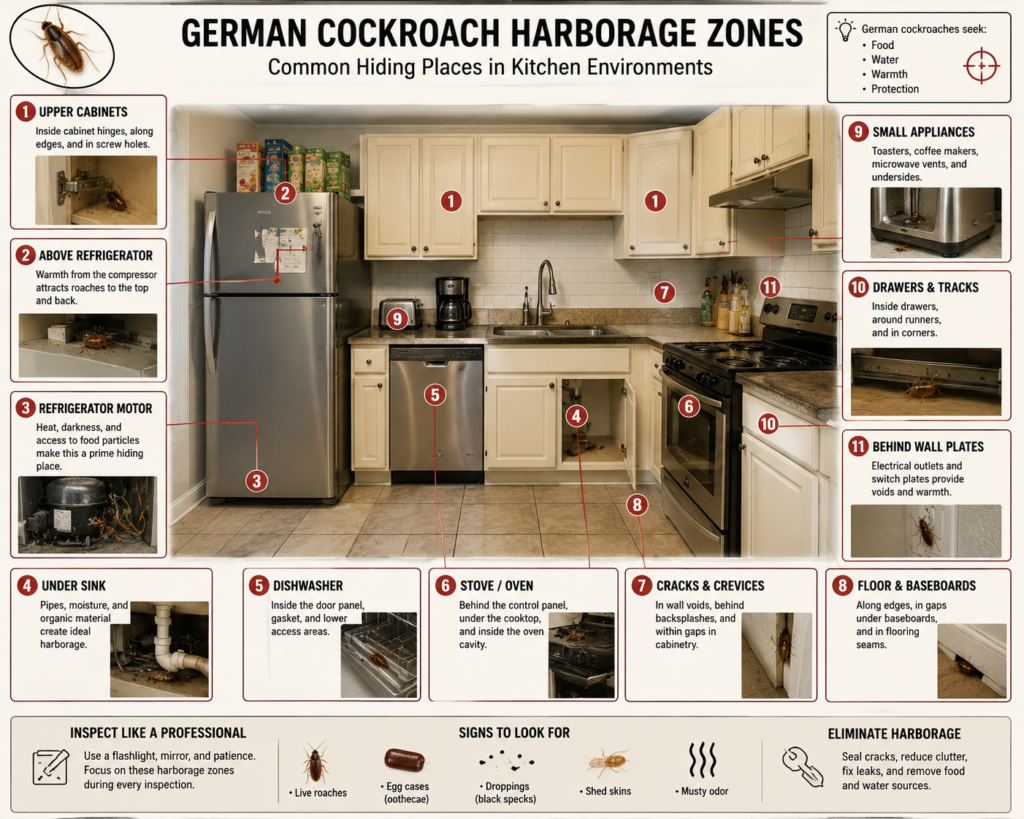
- Address: kitchens and bathrooms, pressed tight to warmth and moisture. Behind the fridge, under the sink, in cabinet seams, around the stove and dishwasher.
Put it together: a small tan roach with two dark stripes behind its head, sprinting from behind your toaster at midnight and refusing to fly, is a German cockroach until proven otherwise. That profile is also why this species is the one that turns a kitchen into a breeding factory. The biology behind that is broken down in the German cockroach behavior and biology guide.
Not Every Small Brown Roach Is German
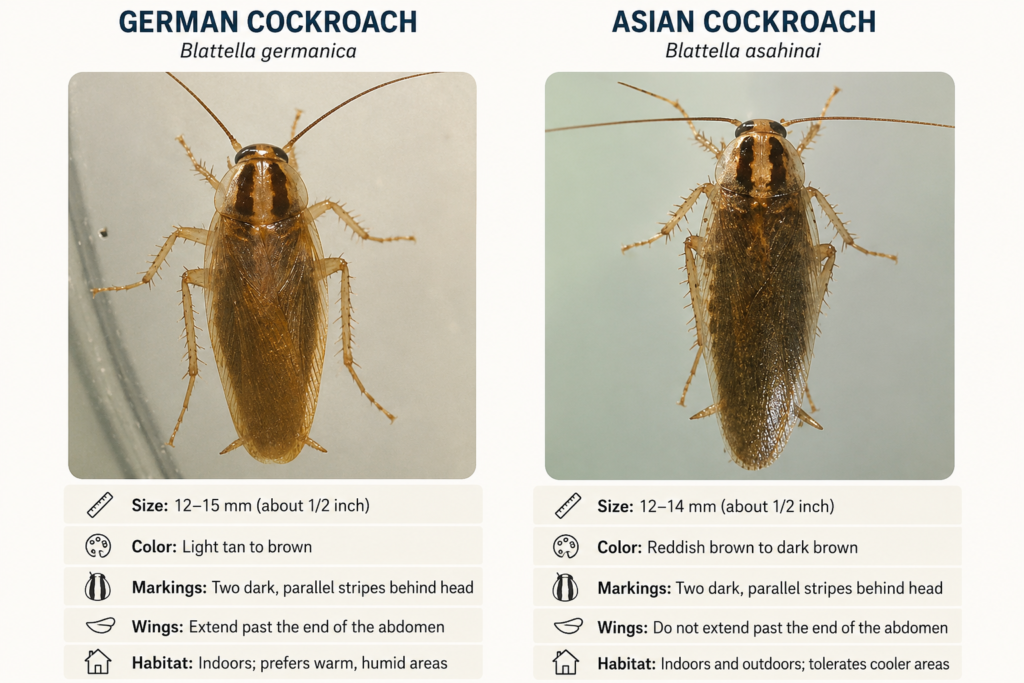
This is where careful identification earns its keep, because two of the German cockroach’s look-alikes change the plan entirely.
- The Asian cockroach is the dangerous double. It is nearly identical in size and color and carries the same two stripes behind the head. The difference is behavior: the Asian cockroach is a strong flier drawn to outdoor lights, and it lives outdoors in mulch and lawns rather than breeding in your kitchen. If your “German cockroach” flew to the porch light, stop and rethink. Chasing it indoors wastes your effort. Full breakdown in the guide on German cockroach vs. Asian cockroach.
- The brownbanded cockroach is close in size but wears light bands running across the wings, not stripes running lengthwise, and it spreads through whole rooms (bedrooms, furniture, high on walls), not just the kitchen. Different distribution, different inspection map.
- The American and oriental cockroaches are the easy ones to rule out: much larger, reddish-brown or nearly black, and tied to basements, drains, and sewers. A big roach coming up from a drain after heavy rain is a completely different problem from tan nymphs living behind your fridge. The species determines the battlefield. See German cockroach vs. American cockroach for the full comparison.
Don’t Identify by Size Alone
The single most common ID mistake: small must mean German, big must mean American. Size shifts with age, sex, nutrition, and species. A young American nymph is small too. Never hang an ID on one feature. Read the whole package: body shape, color, the pronotum markings, wings, antennae, life stage, location, and behavior. One feature is a guess. The stack is a confirmation.
Read the Scene, Not Just the Bug
Often you will find the evidence before you find a live roach, and a scene read correctly tells you more than a single insect ever could. One clue is suspicion. A pattern is intelligence. Here is what to collect (each of these has its own field guide when you need the close-up detail):
- Multiple sizes at once. Tiny nymphs, mid-size juveniles, and adults in the same area means you are not watching random visitors. You are watching generations. That is a breeding population. Nymphs are the highest-value sign; the close comparison against beetles and other small bugs is in the baby German cockroach identification guide.
- Egg cases (oothecae). Small, brown, capsule-shaped, like a tiny ridged purse. The German female carries hers until nearly hatching, so finding one, or an egg-carrying female, means the next generation is already staged. Detail in the guide to German cockroach egg cases.
- Droppings. From German cockroaches they look like coarse black pepper or ground coffee. Tiny dark specks concentrated in corners, drawer tracks, and along cabinet edges where the roaches travel and rest. A stray speck proves little; a concentrated pattern maps their territory. Full read in the German cockroach droppings guide.
- Shed skins (exuviae). Pale, hollow roach-shaped casings. Nymphs molt as they grow, so several shed skins mean immatures have been developing right there.
- Odor. Heavy infestations give off an oily, musty smell. It is real evidence, but it is a late signal. If you can smell it, the population is already established. Your flashlight and monitors are the better early-warning system.
Never lean on one clue when five are available.
Where You Find It Is Intelligence
Anatomy is not the whole ID. Location is a witness. German cockroaches do not scatter at random; they gather where survival is easy: warmth, water, food, darkness, tight spaces, and other roaches. A tan nymph behind a warm dishwasher tells a very different story than a big roach at an exterior door after rain. So when you find one, log the scene. Was it warm? Was water close? Food nearby? A drain, pipe, appliance, or cardboard box within reach? Day or night? Alone, or were smaller ones around it? Those answers point you at the harborage, which is where the fight is actually won.
Daytime Sightings Are a Warning
German cockroaches prefer the dark, so a night sighting is ordinary. Repeated daytime sightings are not, especially nymphs or several roaches at once. Daylight activity usually means the hiding spots are overcrowded and the population is spilling out of its harborages. One daytime roach is not proof of a plague, but a pattern of them is overflow from a colony that no longer fits. There is a dedicated guide on why German cockroaches appear during the day when you want the full read.
Turn Sticky Traps Into Surveillance
Sticky monitors are the simplest confirmation tool you have, and their job is intelligence, not extermination. Do not judge them by kill count. Place them flat against walls, under sinks, behind appliances, inside cabinets, and near suspected harborage. Check them on a schedule and record what you catch: number, size, life stage, and location. That data shows you where activity concentrates and, checked over time, whether the population is climbing or collapsing. Do not just kill roaches. Study the pattern. Good control starts with good intelligence. The full placement-and-reading method is in the German cockroach sticky-monitoring guide.
The Bottom Line
To identify a German cockroach, read the bug, then read the scene.
The bug: a flattened, oval, half-inch body, tan to light brown, with two dark parallel stripes behind the head, long antennae, six spiny legs, and a hard run for the dark instead of flight. Rule out the look-alikes, if it flew, think Asian; if it is banded, think brownbanded; if it is big and reddish from a drain, it is not German at all.
The scene: droppings like black pepper, capsule-shaped egg cases, pale shed skins, multiple life stages, night activity, and a cluster near food, water, and warmth. One clue gives you suspicion. Several give you intelligence, and intelligence is what separates random spraying from control that actually ends the infestation.
Identify what you are fighting before you bait, trap, or spray. The goal was never to swing at whatever runs across the floor. It is to name the enemy, find its territory, and destroy the population at its source. When you have confirmed it is German, the German Cockroach Field Manual lays out the elimination system from here.
Frequently Asked Questions
What does a German cockroach look like?
A German cockroach is small, about half an inch, and light brown to tan, with two dark parallel stripes running lengthwise down the shield behind its head. Adults have wings but almost never fly; they run for the nearest dark crack when exposed.
How do I tell a German cockroach from an Asian cockroach?
They look nearly identical (same size, color, and twin stripes), so go by behavior. The Asian cockroach is a strong flier that lives outdoors and heads for lights. The German cockroach rarely flies and breeds indoors, especially in kitchens and bathrooms. If it flew to your porch light, it is probably Asian.
Are all small brown roaches German cockroaches?
No. Size and color alone do not confirm the species. Young American and other roaches are small too. Look for the two lengthwise stripes behind the head, then check the location and behavior. One feature is a guess; the full profile is a confirmation.
What do German cockroach droppings look like?
Like coarse black pepper or ground coffee. Tiny dark specks, not solid pellets. They collect in corners, drawer tracks, and along cabinet edges where roaches travel and rest. A single speck means little; a concentrated pattern maps their territory.
Do German cockroaches fly?
Adults have fully developed wings but almost never fly. They rely on speed and run for cover instead. A similar-looking roach actively flying, especially toward outdoor lights, is more likely an Asian cockroach.
Why am I seeing German cockroaches during the day?
German cockroaches prefer the dark, so repeated daytime sightings usually signal crowding. The hiding spots are full and the population is spilling out. One daytime roach is not proof of a heavy infestation, but a pattern of them points to a larger, established colony.
Sources
- NC State Extension. German Cockroach: Biology, Identification, Control. Confirms the size, color, and twin pronotal stripes that identify the species. View publication
- University of Florida IFAS. Asian Cockroach, Blattella asahinai (EENY-120). Confirms the near-identical stripe pattern and the flight and light behavior that separates it from the German cockroach. View publication
- Penn State Extension. Brown-banded Cockroaches: confirms the crossbands versus stripes distinction and the dry, elevated harborage preference. View publication