A German cockroach on your floor is not a random visitor. It’s evidence. If you’re asking why German cockroaches infest buildings, the answer is hiding in your walls, cabinets, or appliances: your building is handing this insect everything it needs to live, and it moved in because you made it easy without knowing it.
That reframes the whole problem. The useful question is never “where did this roach come from.” It is “what is this building giving them that lets them survive and multiply?” Answer that and you understand why the infestation started, why it is sticking, and, the part that stings for a lot of people, why a clean home is not immune.
Your Building Is an Ecosystem, Not Just a Shelter
Outdoors, a cockroach fights the weather, predators, drought, and seasonal starvation. Inside a heated building, all of that goes away. Stable temperature year-round. Water on tap. Food arriving daily. Thousands of cracks to hide in. From the roach’s point of view, you did not build a house. You built a climate-controlled cave stocked with supplies.
German cockroaches are indoor specialists, evolved to exploit exactly this. How they exploit it so efficiently (the reproduction, the hiding, the resistance) is the insect’s own machinery, covered in the German cockroach behavior and biology guide. This article is about the other half of the equation: what the building supplies, and how to stop supplying it.
“Why German Cockroaches Infest Buildings: The Five Things It Runs On”
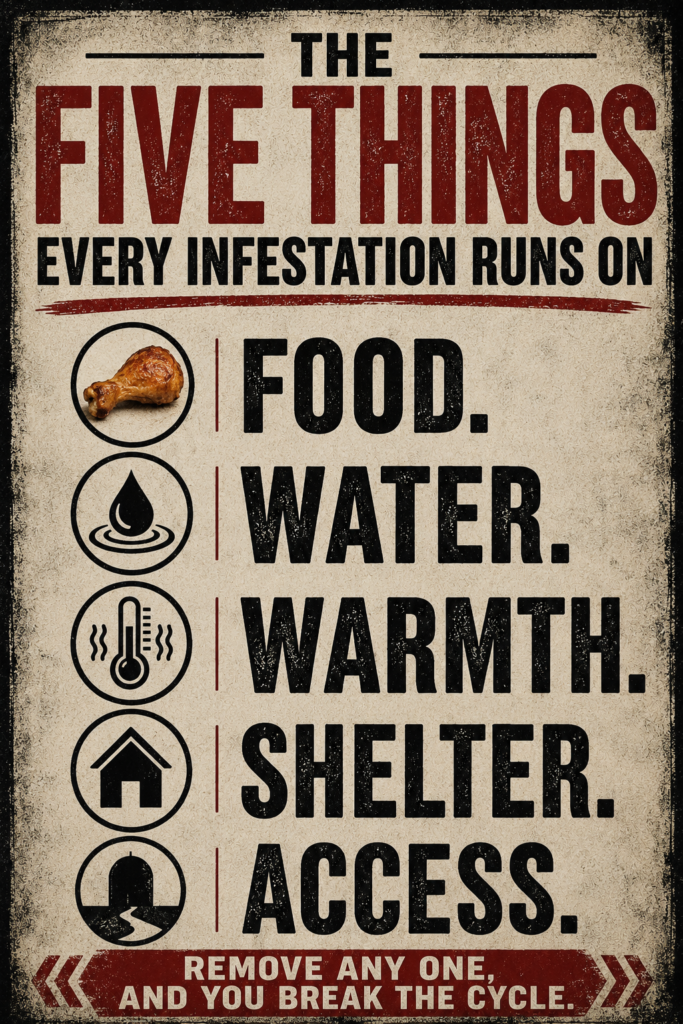
Strip it down and every German cockroach infestation depends on five resources:
Food. Water. Warmth. Shelter. Access.
That list is also your leverage. This is the core principle of Integrated Pest Management: you are not just killing insects, you are making the environment less able to support them. Every resource you remove is pressure on the population. Leave them all available and roaches settle in for good. (New to IPM? The free field overview You Were Never Taught This breaks down the whole framework.)
Food: They Eat What You Can’t Even See
German cockroaches are scavengers, and they do not need a mess. A thin film of grease behind the stove is a meal. So are crumbs under the fridge, residue in a cabinet hinge, pet food, cardboard, and the smear on a dish left overnight. You look at a crumb and see nothing. A roach sees dinner.
That is why sanitation is a real control lever, not housekeeping advice. Every food source you remove sharpens competition and makes your bait the best meal in the room. But it is also why cleaning alone rarely ends an infestation: the scattered, hidden food is nearly impossible to erase completely. You are cutting supply lines, not flipping a switch. For the full breakdown of their diet and how it drives bait performance, see the guide on what German cockroaches eat.
Water: The Resource That Anchors Them
Roaches can go longer without food than without water, which is why moisture often decides where a population sets up. Kitchens and bathrooms win because they stack water with warmth and food. And the sources do not have to be dramatic. Condensation under the fridge, a slow drip under the sink, a damp sponge, a pet bowl, sweating pipes inside a cabinet. Fix the leaks and dry out those pockets and you have pulled a leg out from under the colony.
Warmth and Shelter: Behind the Machinery Is Another World
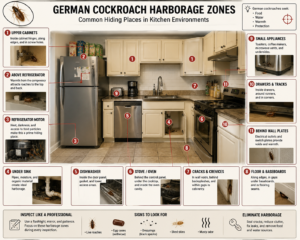
German cockroaches are thigmotactic. They want their bodies pressed against surfaces on all sides, so they seek tight, warm, dark cracks. Your building is full of them, and your appliances are the prize: a refrigerator compressor throws heat, food debris collects beneath it, condensation adds water, and the mechanical cavity is a fortress. The room looks spotless. Behind the machinery it is heat, grease, moisture, darkness, and cover all at once. That is prime territory, and it is why the roaches on the floor are only the fraction that left cover. Where they hide, in detail, is its own guide on where German cockroaches hide.
Why Even Spotless Homes Get German Cockroaches
Here is the misconception that keeps infestations alive: roaches mean you are dirty. False, and believing it is how the problem gets worse.
German cockroaches are expert hitchhikers. They ride in on groceries, cardboard boxes, deliveries, used appliances, secondhand furniture, luggage, and backpacks, and in an apartment, straight through the shared wall from a neighbor. That is how an immaculate home, a well-run hotel, or a professional kitchen still ends up with them. Cleanliness controls whether the population thrives; it does not control whether one arrives.
The reason this matters is not comfort. It is tactics. Shame makes people hide an infestation, and delay hands the colony weeks to breed and spread. So drop “who is dirty?” and ask the questions that actually solve it: How did they get in? Where are they established? What is supporting them? How are they moving? When the answer is a secondhand appliance, inspect it before it crosses your door. See the guide on how to inspect used appliances for cockroaches.
Apartments: You Can Win Your Unit and Lose the Building
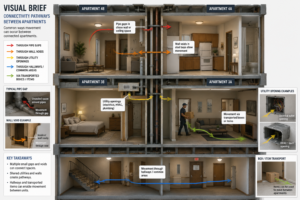
Multi-unit housing is the hardest case, because your apartment is not sealed. Shared walls, stacked plumbing, common utility lines, hallways, and trash rooms are all highways. You can treat your kitchen perfectly while the units on either side stay infested, and the survivors simply walk back in through the pipe penetrations. That is why serious apartment infestations need coordinated inspection and treatment across units, not one-door heroics. The full breakdown of why apartments spread infestations between units, and what a resident can actually do about it, is in the guide on German cockroaches in apartments. The full inspection playbook is the 47-Point Inspection: every harborage, entry point, and shared-wall route, mapped in order.
Clutter: Territory You’re Handing Them
Clutter does not create roaches, but it arms an infestation. Cardboard boxes, paper bags, stacked storage, and crammed cabinets multiply the hiding places and make inspection and treatment miserable. Cardboard is the worst offender. It shelters roaches and ferries them and their egg cases from place to place. Clearing clutter takes territory back and makes everything else you do work better. Prevention as a full system lives in the guide on preventing German cockroaches.
Why They Stay Once They’re In
Once a building supplies food, water, warmth, shelter, and other roaches to breed with, the population has no reason to leave and every reason to grow. And past that point, stepping on the occasional roach accomplishes almost nothing. The building is supporting a system, and the system is mostly hidden.
To end it, you attack what keeps it alive: reduce the food, kill the moisture, clear the clutter, seal the movement routes you can reach, monitor to find the harborages, deploy bait and growth regulators correctly, and follow up until the population collapses. The goal is not to make the roaches uncomfortable. It is to make survival impossible.
The Bottom Line
German cockroaches infest buildings because buildings are, from an insect’s point of view, close to perfect: food, water, warmth, shelter, and a constant stream of transportation in. They do not wander in and hang around. They exploit what they find, hide in the structure, breed, and spread, and they will do it in a spotless home as readily as a filthy one.
So when you see one, read it correctly. You did not just spot a bug. You spotted proof that somewhere in the building, the conditions for survival exist. Find those conditions, change them, and destroy the population at its source. The full system is laid out in The Roach Doctrine.
Frequently Asked Questions
Why do I have German cockroaches if my house is clean?
Because cleanliness controls whether a population thrives, not whether one arrives. German cockroaches hitchhike in on groceries, cardboard, used appliances, luggage, and through shared apartment walls. A spotless home can still receive them; good sanitation just makes it harder for them to establish.
What attracts German cockroaches?
Food, water, warmth, and tight hiding spaces, usually in tiny, hidden amounts. A grease film behind the stove, condensation under the fridge, crumbs in a cabinet, and warm appliance cavities are enough. They concentrate in kitchens and bathrooms because those areas combine all four.
How do German cockroaches get into a home?
Almost always by hitchhiking. They ride in on grocery bags, cardboard boxes, deliveries, secondhand appliances and furniture, luggage, and backpacks, or move in through walls and plumbing from a neighboring apartment. They rarely march in across a yard.
Can you get rid of German cockroaches by cleaning alone?
Usually not. Sanitation is a powerful lever, it starves competing food sources and makes bait more effective, but German cockroaches survive on scattered, hidden food that is nearly impossible to remove completely. Cleaning supports control; it rarely finishes an infestation by itself.
Why do German cockroaches keep coming back?
Because the conditions that supported them are still there, or because they are re-entering from an untreated source. In apartments, roaches routinely move back through shared walls and pipes from neighboring units. Lasting control means removing the resources and, in multi-unit buildings, treating the problem building-wide.
Where do German cockroaches hide in a house?
In tight, warm, dark spaces close to food and water. Behind and under refrigerators, stoves, and dishwashers, inside cabinet seams, wall voids, and cracks, and around plumbing. Kitchens and bathrooms are the usual centers because they combine warmth, moisture, and food.